Hair loss may progress even when traditional hair-care measures are followed, which has led to growing interest in regenerative approaches that focus on supporting the health of existing hair follicles. Stem cell transplantation is one such approach for hair restoration.
Unlike a conventional hair transplant, where hair follicles are extracted and implanted in the scalp, stem cell-based procedures use regenerative cells to support the scalp and existing follicles. Understanding the procedure, what it intends to achieve, and when results may become visible may help the patients to better decide about the approach.
What Is Stem Cell Transplant for Hair?
Stem cell transplant for hair is a regenerative treatment that supports weakened hair follicles. Regenerative cells are obtained from the patient’s own body, processed, and then introduced into areas of thinning hair.
A stem cell-based approach does not relocate hair follicles from a donor area to a recipient area, instead it creates a more supportive environment for existing follicles and encourages their normal biological activity.
Stem cell transplantation does not necessarily mean creating new hair follicles.
How Does Stem Cell Transplant Work for Hair Loss?
The treatment relies on the regenerative potential of cells containing growth-supporting factors, which are injected into areas affected by hair thinning to interact with the surrounding scalp tissue.
The procedure aims to support cellular activity, improve the local tissue environment, and help weakened follicles function efficiently.
What is the Procedure of Stem Cell Transplant for Hair?
The technique of a stem cell transplant may vary as per the patients, but it generally involves several stages.
1. Hair and Scalp Assessment: The procedure begins with an evaluation of the patient’s hair loss pattern, scalp condition, and follicle health. This assessment helps determine if a regenerative approach is suitable for thinning areas.
2. Collection of Regenerative Material: Cells or tissue containing regenerative components may be collected from the patient’s own body. Using a patient’s own tissue or cell is known as an autologous approach.
3. Processing and Preparation: The collected material or tissue is processed as per the technique, to prepare the regenerative material.
4. Application to the Scalp: The prepared material is then injected into selected areas of hair thinning. The method of delivery may depend on the technique being used.
5. Post-Treatment Monitoring: After the procedure, the treated areas are checked and the patient is given appropriate instructions for the initial recovery period. The surgeon may recommend follow-up sessions to assess how the scalp and hair respond.
What Are the Potential Benefits of Stem Cell Transplant for Hair?
Regenerative stem cell approaches support existing follicles rather than relocate hair from one area to another. Potential benefits may include:
- Supporting weakened or miniaturised follicles
- Improving the local scalp environment
- Supporting healthier hair growth
- Improving hair thickness or density in suitable patients
- Providing a regenerative option for certain types of hair loss
The results should not be considered guaranteed. The condition of the existing follicles, cause of hair loss, treatment protocol, and individual response can all influence the outcome.
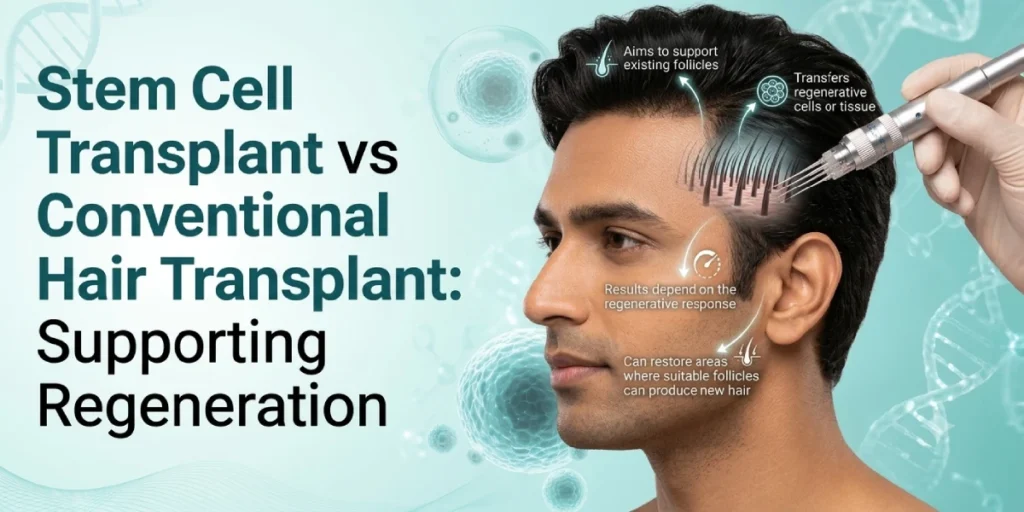
Stem Cell Transplant vs Conventional Hair Transplant
| Stem Cell Transplant | Conventional Hair Transplant |
| Aims to support existing follicles | Transfers hair follicles from a donor area |
| Uses regenerative cells or tissue, depending on the technique | Uses actual hair grafts |
| Does not primarily redistribute donor hair | Restributes donor follicles to areas of hair loss |
| May be considered when viable follicles remain | Can restore areas where suitable donor follicles can be transplanted |
| Results depend on the regenerative response | Transplanted follicles can produce new hair in the recipient area |
When Will Patients See Results After Stem Cell Therapy?
One of the important things to understand after stem cell therapy is that hair growth takes time and does not grow overnight. The treatment is performed to support the health and function of existing hair follicles.
The timeline of results may vary from person to person; some patients may notice early changes within a few months, while more improvements in hair thickness or density can take several months. The result depends on factors such as the underlying causes of hair loss, the condition of the existing follicles, and individual response.
The treatment is not unsuccessful if the improvement is not visible immediately after the treatment.
Stem Cell Therapy Recovery Time
The healing phase after stem cell therapy is short, but the timeline may depend on the treatment technique and individual response.
| Time After Treatment | What You May Expect |
| First few days | Mild redness or minor swelling may occur |
| First 1-2 Weeks | The scalp continues to heal |
| 1-3 Months | Early changes may begin to appear in some patients |
| 3-6 Months | Improvements in hair density and thickness may become more noticeable |
| Over 6 Months | Further improvements occur until the outcome is visible |
What Factors Can Affect Your Results?
Several factors may influence how the hair responds to treatment:
Cause of hair loss: The reason for hair loss may influence treatment response.
Extent of hair loss: Treatment may be more appropriate when hair follicles are still present in the treated areas.
Follicle health: The condition of existing follicles plays an important role in improvement.
Nutritional status: Deficiencies in certain nutrients may contribute to hair problems.
Other medical conditions: Underlying health conditions or hormonal causes may affect hair growth.
Following aftercare: Adhering to the doctor’s recommendations helps support appropriate recovery.
Conclusion
Stem cell transplant for hair is a regenerative approach that supports weakened hair follicles. The procedure involves collecting regenerative material, processing it, and introducing it into areas affected by hair thinning.
The potential for improvement depends on factors such as the cause and extent of hair loss, the condition of existing follicles, the treatment method used, and the individual’s response. It is therefore important to have realistic expectations, and most importantly, remember that recovery happens before results.
Hair follicles require time to move through their natural growth cycle, so improvements in thickness and density should be assessed over the following months rather than days or weeks.
At Dr. Kumar’s Hair Care Clinic, the progress can be monitored after treatment so that the recovery and hair-growth response can be assessed appropriately.
Frequently Asked Questions (FAQs)
Is stem cell transplant suitable for everyone?
The benefit of regenerative hair treatment for patients depend on the presence of viable hair follicles that can still respond. A proper assessment is useful while choosing a treatment for hair restoration.
Can stem cell therapy be repeated if the results are not satisfactory?
Whether treatment can be repeated depends on the response and the condition of the scalp and follicles.
Does stem cell transplant create new hair follicles?
Stem-cell based hair treatment are intended to support the a ctivity and health of existing follicles.
Can stem cell therapy be combined with other hair-loss treatments?
It may be possible to combine regenerative therapy with other treatments, but the combination should be planned by a certified doctor.
Can women undergo stem cell transplant for hair loss?
Yes, women may be considered for regenerative hair treatments, but identifying the cause is important before deciding if a stem cell based approach is suitable.
How many stem cell treatment sessions are required?
The requirement for treatment sessions depends on the procedure, extent of hair loss, and the doctor’s assessment.
Is the stem cell material taken from the patient’s own body?
Some hair-restoration approaches use an autologous method, which means that the regenerative material is obtained from the patient’s own tissue.
Can stress affect hair growth after stem cell therapy?
Stress may influence the normal hair growth cycle and may contribute to increased shedding in some individuals.