Hair loss as a concern and how people see it, has evolved to a topic people actively seek solutions for. In 2026, the focus is no longer just on slowing hair fall, it’s about reviving hair growth at a cellular level.
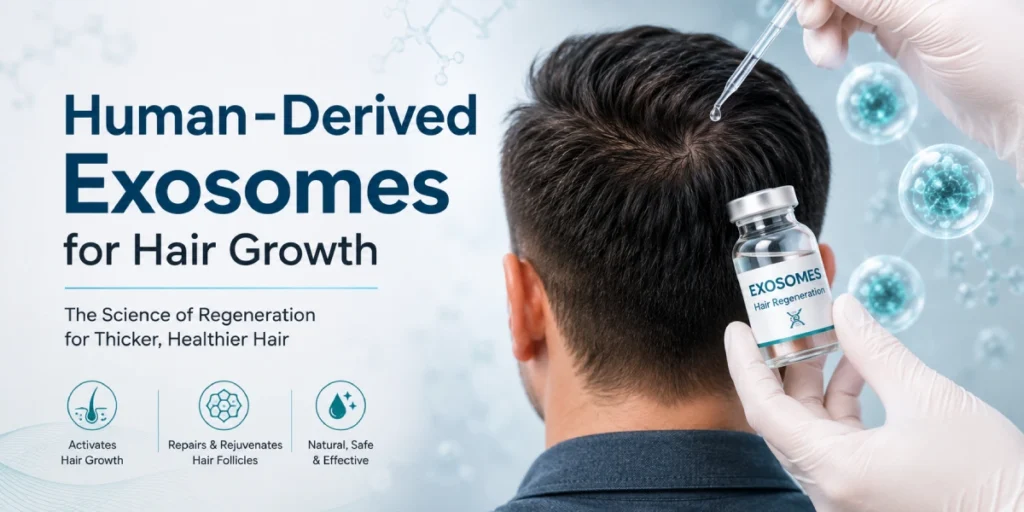
Among the newer advancements in this space, human-derived exosomes are steadily gaining attention. They are often described as the next step beyond treatments like P-R-P and GFC, especially for people looking for more refined, science-backed solutions.
But what exactly are exosomes, and how do they help with hair growth?
Let’s break it down in a way that feels simple, clear, and actually useful.
What Are Human-Derived Exosomes?
Exosomes are extremely small particles released naturally by cells in the body. Their main job is communication—they carry signals from one cell to another.
These signals include:
- Growth factors
- Proteins
- Genetic instructions (RNA)
When used in hair treatments, these exosomes treatment are introduced into the scalp to stimulate hair follicles and improve their function.
In simpler terms:
They tell your hair follicles to “wake up” and start working better.
How Do Exosomes Help in Hair Growth?
Hair thinning and hair loss often happen because hair follicles become weak, inactive, or poorly nourished.
Exosomes work by:
- Activating dormant hair follicles
- Improving blood flow to the scalp
- Enhancing the hair growth cycle
- Strengthening existing hair strands
Unlike traditional treatments that focus on one pathway, exosomes work on multiple levels of hair regeneration, which is why they’re considered more advanced.
Why Are Exosomes Becoming Popular in 2026?
There’s a clear shift in how people approach hair treatments today. Patients are more informed and expect treatments that are:
- Effective
- Minimally invasive
- Backed by science
Exosomes fit into this space because they focus on regeneration rather than temporary correction.
Some key reasons for their growing popularity:
- Advanced Technology
They deliver ready-to-use regenerative signals directly to the scalp. - Faster Response
Since they don’t rely entirely on your body to produce growth factors, results can feel more efficient. - Non-Surgical Approach
No incisions, no major downtime—just targeted therapy. - Suitable for Early to Moderate Hair Loss
They work particularly well when hair follicles are still present but weakened.
Exosomes vs P-R-P vs GFC (For Hair)
To understand exosomes better, it helps to compare them with commonly known treatments:
P-R-P (Platelet-Rich Plasma)
- Uses your own blood
- Releases growth factors gradually
- Requires multiple sessions
GFC (Growth Factor Concentrate)
- More refined version of P-R-P
- Higher concentration of growth factors
- Fewer sessions than P-R-P
Exosomes
- Deliver pre-formed, highly potent signals
- Work more directly on follicle activation
- Represent a more advanced, targeted approach
The key difference:
P-R-P and GFC stimulate your body to create signals
Exosomes deliver those signals directly
This is why many consider exosomes a next-generation solution in hair restoration.
Who Is a Good Candidate for Exosome Therapy?
Exosome treatment works best for individuals who:
- Are experiencing early to moderate hair thinning
- Have active but weakened hair follicles
- Are noticing increased hair fall due to stress or hormonal changes
- Want a non-surgical solution before considering a transplant
At Dr Kumar’s Hair Transplant Clinic in Kondapur, Hyderabad, exosome therapy is often suggested for patients who want to take a proactive approach, especially when hair loss is still in a reversible stage.
What Happens During the Procedure?
The procedure is simple and comfortable.
- The scalp is cleaned and prepared
- Microneedling or micro-injections are performed
- Exosomes are applied or injected into the scalp
The entire process usually takes about 45 to 60 minutes.
There’s no need for hospitalization, and you can go back to your routine the same day.
One of the biggest advantages of exosome therapy is how convenient it is.
- Mild redness or sensitivity may occur
- Most people recover within 24 hours
This makes it a practical option for professionals and anyone who doesn’t want long recovery periods.
When Will You See Results After Human-Derived Exosomes Treatment?
Hair treatments always require some patience, and exosomes are no different.
Typical timeline:
- Reduced hair fall: within a few weeks
- Improved hair quality: 1–2 months
- Noticeable growth: 2–4 months
Because exosomes work at a deeper level, results tend to look natural and progressive, rather than sudden or artificial.
Are Exosomes Safe?
When performed in a proper clinical setting, exosome therapy is considered safe.
- They are carefully processed and sterilized
- Designed specifically for medical use
- Minimal risk of allergic reactions
At Dr Kumar’s Hair Transplant Clinic, treatments are carried out under strict protocols and supervision of Dr. Ashok Kumar, ensuring both safety and effectiveness.
Are There Any Limitations of Human Exosomes?
While exosomes are promising, they are not a miracle cure for all stages of hair loss.
- They may not be effective in advanced baldness where follicles are no longer active
- Results vary depending on individual biology
- Multiple sessions may be needed for best outcomes
In some cases, exosomes are used along with other treatments like P-R-P or even post-hair transplant to enhance results.
How Do Exosomes Fit Into the Bigger Picture?
Think of hair restoration as a spectrum:
- Early stage – Exosomes, P-R-P, GFC
- Moderate stage – Combination therapies
- Advanced stage– Hair transplant
Exosomes sit at the advanced end of non-surgical treatments, offering a bridge between basic therapies and surgical solutions.
Final Thoughts
In 2026, hair restoration is becoming more intelligent and personalized. Treatments like exosomes reflect this shift—they don’t just try to “fix” hair loss, they aim to improve how your scalp functions at a deeper level.
- They are advanced
- They are minimally invasive
- They focus on regeneration
But like any treatment, their effectiveness depends on timing and suitability.
If you’re noticing early signs of hair thinning and want to act before it progresses further, exosome therapy can be a valuable option to explore.
At the same time, the right approach always comes down to proper evaluation. Clinics like Dr Kumar’s Hair Transplant Clinic in Kondapur, Hyderabad, led by Dr. Ashok Kumar, focus on helping patients understand where they stand—and what treatment makes the most sense for them.
Because when it comes to hair, the goal isn’t just growth, it’s sustainable, natural, and confident results.