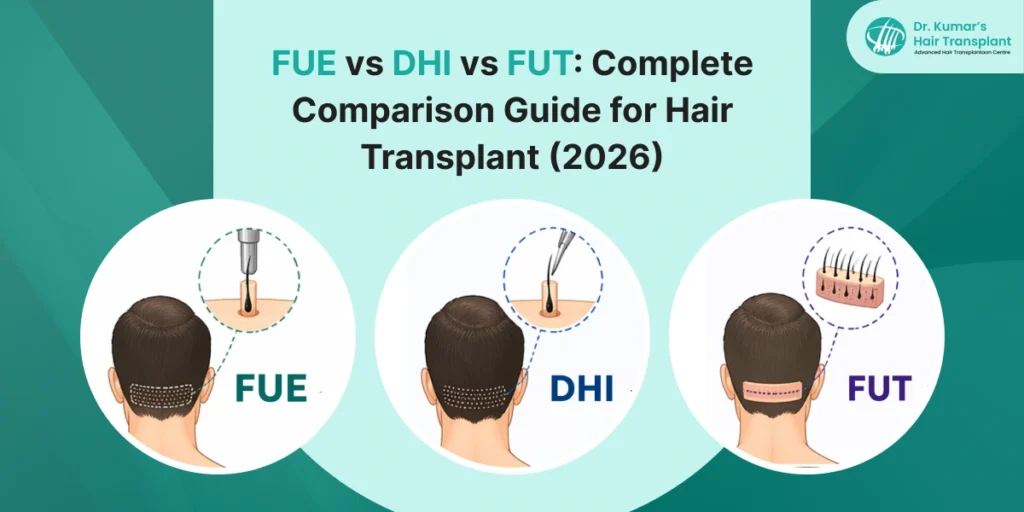
Hair loss is no longer a concern people choose to live with. In 2026, conversations around hair restoration have become more open, informed, and solution-driven. With advancements in medical technology, hair transplant procedures have evolved to offer natural-looking results with minimal downtime.
But with options like FUE, DHI, and FUT available, one common question patients ask is:
Which hair transplant technique is right for me?
The answer depends less on trends and more on your individual hair loss pattern, scalp condition, and expectations. At Dr Kumar’s Hair Transplant Clinic in Kondapur, Hyderabad, this is exactly where expert guidance plays a crucial role. Under the experience of Dr. Ashok Kumar, patients are not rushed toward a single method. Instead, they are helped to understand what works best for their unique case.
Let’s break down these three techniques in a simple, clear, and practical way.
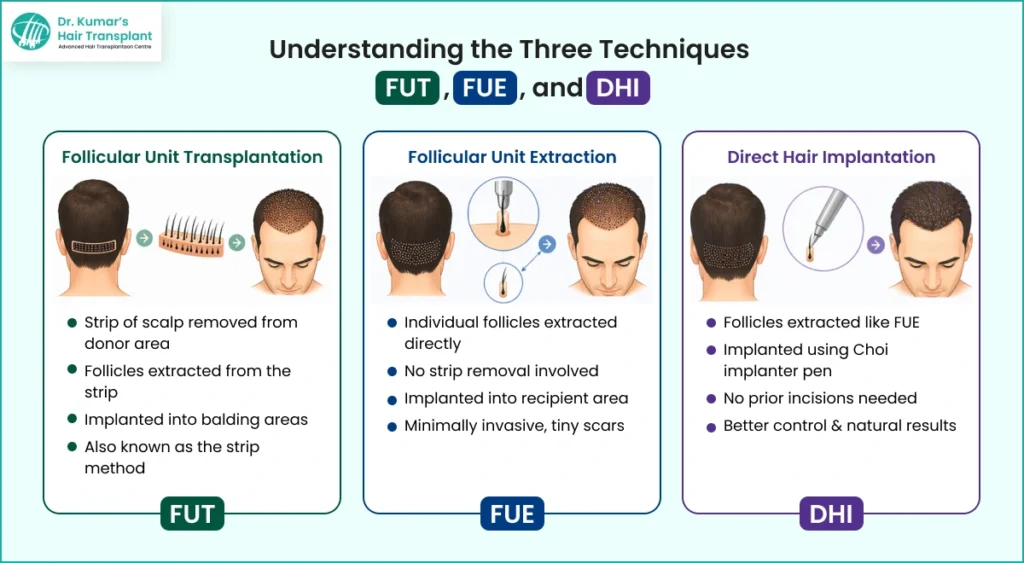
Understanding the Three Techniques – FUT, FUE, and DHI
1. FUT (Follicular Unit Transplantation)
FUT is one of the earliest hair transplant techniques and is still widely used in specific cases.
- A strip of scalp is removed from the donor area (usually the back of the head)
- Hair follicles are extracted from this strip
- These follicles are then implanted into the balding areas
It is often referred to as the “strip method.”
2. FUE (Follicular Unit Extraction)
FUE is a more advanced and widely preferred technique today.
- Individual hair follicles are extracted directly from the donor area
- No strip removal is involved
- The follicles are then implanted into the recipient area
This method is minimally invasive and leaves tiny, almost invisible scars.
3. DHI (Direct Hair Implantation)
DHI is a refined version of FUE.
- Hair follicles are extracted similarly to FUE
- However, implantation is done using a special tool (Choi implanter pen)
- This allows direct placement without creating prior incisions
DHI offers more control over the angle, depth, and direction of hair placement.
The 2026 Shift: Why Technique Selection Matters More Than Ever
Today’s patients are not just looking for hair; they’re looking for natural density, minimal downtime, and long-term results.
With improved techniques and tools, all three methods – FUT, FUE, and DHI—have their place in modern hair restoration. The key is choosing the right approach based on:
- Extent of hair loss
- Donor hair availability
- Lifestyle and recovery expectations
- Budget considerations
G-F-C’s concentrated growth factors can stimulate follicles more efficiently, which is why many clinics are shifting towards it.
Detailed Comparison: FUE vs DHI vs FUT

1. Invasiveness
- FUT: More invasive due to strip removal
- FUE: Minimally invasive
- DHI: Minimally invasive with added precision
Insight:
FUE and DHI are generally more comfortable options compared to FUT.
2. Scarring
- FUT: Leaves a linear scar at the donor site
- FUE: Leaves tiny dot-like scars (barely visible)
- DHI: Similar to FUE, minimal scarring
Insight:
If you prefer shorter hairstyles, FUE or DHI may be more suitable.
3. Recovery Time
- FUT: Longer recovery due to stitches
- FUE: Faster recovery (within a few days)
- DHI: Similar to FUE, sometimes slightly quicker
Insight:
FUE and DHI are more convenient for people with busy schedules.
4. Natural-Looking Results
- FUT: Good results when done well
- FUE: Very natural results
- DHI: Highly natural due to precise implantation
Insight:
DHI allows more control, but all three can deliver excellent results in experienced hands.
5. Graft Survival Rate
- FUT: High survival rate
- FUE: High survival rate
- DHI: Often slightly higher due to minimal handling of grafts
Insight:
Differences exist, but technique alone doesn’t determine success—execution matters more.
6. Procedure Duration
- FUT: Usually shorter for large graft numbers
- FUE: Time-consuming
- DHI: Can take longer due to precision implantation
Insight:
FUT may be preferred when a large number of grafts are needed in one session.
7. Cost
- FUT: Generally the most affordable
- FUE: Moderately priced
- DHI: Usually the most premium
Insight:
Cost often reflects the technology and time involved.
8. Ideal Candidates
FUT:
- Advanced hair loss
- Need for a large number of grafts
- Not concerned about linear scarring
FUE:
- Moderate hair loss
- Prefer minimal scarring
- Want flexibility in hairstyles
DHI:
- Early to moderate hair loss
- Looking for high precision and density
- Focused on natural hairline design
Comparison Summary:
| Factor | FUT | FUE | DHI |
| Technique Type | Strip method | Individual extraction | Advanced FUE (direct implant) |
| Invasiveness | Moderate | Minimal | Minimal |
| Scarring | Linear scar | Tiny dot scars | Tiny dot scars |
| Recovery Time | Longer | Faster | Faster |
| Natural Results | Good | Very good | Highly precise |
| Procedure time | Short | Moderate | Longer |
| Cost | Lower | Medium | Higher |
| Best For | Advanced hair loss | Most common cases | Precision-focused results |
How Do You Choose the Right One?
This is where most people get confused and understandably so.
There is no single “best” technique. Each method works well when used in the right context.
At Dr Kumar’s Hair Transplant Clinic, patients are evaluated based on:
- Hair density in the donor area
- Pattern of baldness
- Scalp flexibility
- Desired hairline and coverage
For example:
- A patient with advanced baldness may benefit from FUT for maximum graft extraction
- Someone looking for minimal downtime may lean toward FUE
- A patient focused on hairline precision and density may consider DHI
Often, the recommendation is not about choosing what’s trending—but what’s technically most suitable.
The Role of the Surgeon Matters More Than the Technique
One important truth that often gets overlooked:
The success of a hair transplant depends more on the surgeon’s skill than the technique itself.
A well-executed FUT can outperform a poorly done DHI, and vice versa.
This is why experience, planning, and execution are critical. Under the guidance of Dr. Ashok Kumar, the focus is not just on performing a procedure but on ensuring:
- Natural hairline design
- Proper graft handling
- Long-term sustainability of results
Final Thoughts
In 2026, hair transplant procedures are more advanced, accessible, and effective than ever before. FUE, DHI, and FUT are not competing techniques, but they are different tools designed for different needs.
- FUT offers efficiency for large graft requirements
- FUE provides a balance of comfort and natural results
- DHI enhances precision and density
The right choice lies in understanding your own hair loss pattern and working with an experienced specialist who can guide you honestly.
If you’re considering a hair transplant, take the time to explore your options and get a personalized assessment. Clinics like Dr Kumar’s Hair Transplant Clinic in Kondapur, Hyderabad aim to simplify this journey, helping you move from confusion to clarity, and eventually, to confident results.
Because at the end of the day, it’s not just about restoring hair – it’s about restoring how you feel about yourself.