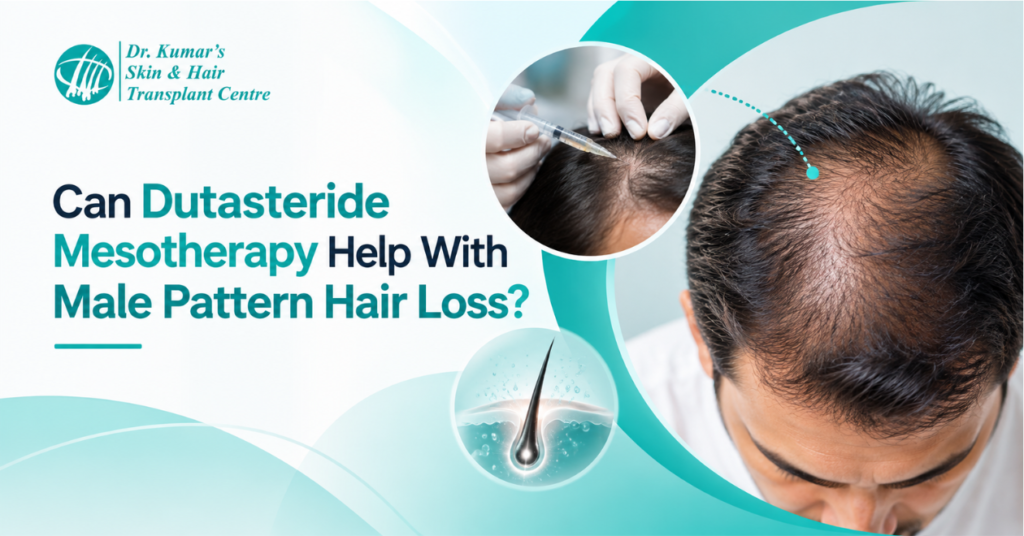
Noticing more hair on your pillow, in the shower, or while combing can be worrying. For many men, gradual thinning around the hairline, temples, or crown may be a sign of male pattern hair loss.
The good news is that hair loss does not always mean you need a hair transplant. Depending on the cause and stage of hair loss, different medical treatments may help slow progression and support existing hair.
One treatment that has gained attention is dutasteride mesotherapy. But can it really help with male pattern hair loss? Let’s understand how it works and who may benefit.
What is Male Pattern Hair Loss?
Male pattern hair loss, also called androgenetic alopecia, is a common form of hair loss in men.
It is influenced by genetics and the hormone dihydrotestosterone (DHT). In susceptible hair follicles, DHT can gradually cause follicles to become smaller. Over time, the affected hairs may become thinner and shorter.
Hair loss commonly begins around:
- Temples
- Hairline
- Crown
- Top of the scalp
Without appropriate management, thinning may gradually become more noticeable.
What is Dutasteride?
Dutasteride is a medication that reduces the conversion of testosterone into DHT by inhibiting the enzymes responsible for this conversion.
Since DHT is involved in male pattern hair loss, reducing DHT activity may help slow hair follicle miniaturization in suitable patients.
Dutasteride can be used in different ways and treatment should always be decided by a qualified doctor after evaluating the individual’s hair-loss pattern and medical history.
What is Dutasteride Mesotherapy?
Dutasteride mesotherapy for hair loss involves delivering a dutasteride-containing preparation through multiple small injections into the scalp.
The treatment is intended to act around the areas affected by hair thinning while using a local injection approach.
The exact technique, concentration, frequency, and treatment protocol can vary between clinics and should be determined by a trained medical professional.
How Can Dutasteride Mesotherapy Help with Hair Loss?
The main goal is to address the hormonal component associated with male pattern hair loss.
By reducing DHT activity around susceptible hair follicles, dutasteride may help:
- Slow further hair thinning
- Reduce follicle miniaturization
- Support existing weakened follicles
- Maintain hair density in suitable patients
However, the response varies from person to person. Dutasteride mesotherapy should not be viewed as a guaranteed way to regrow hair in areas where follicles have been permanently lost.
Can Dutasteride Mesotherapy Regrow Hair?
This is an important question.
Treatment may help improve the appearance of thinning hair when viable follicles are still present. However, it cannot recreate follicles that are completely destroyed or absent.
The potential response depends on factors such as:
- Stage of male pattern hair loss
- Duration of hair loss
- Hair follicle condition
- Age
- Genetics
- Scalp health
- Other treatments being used
Early evaluation can therefore be helpful when progressive thinning is noticed.
Who may be Considered for Dutasteride Mesotherapy?
It may be considered for some men with androgenetic alopecia, particularly when there is visible thinning but sufficient viable hair follicles remain.
Before treatment, a doctor may assess:
- Pattern and severity of hair loss
- Scalp condition
- Family history
- Previous hair-loss treatments
- Medical history
- Current medications
- Overall suitability for dutasteride-based treatment
Not every man with hair loss needs or is suitable for this treatment.
Why Proper Diagnosis Matters
Not every case of hair loss in men is caused by male pattern hair loss.
Hair thinning can also occur due to:
- Nutritional deficiencies
- Thyroid problems
- Stress
- Illness
- Scalp disorders
- Certain medications
- Autoimmune conditions
- Other medical causes
Treating the wrong cause may delay appropriate care.
A proper hair and scalp assessment can help determine whether androgenetic alopecia is responsible and whether dutasteride-based treatment is appropriate.
When should you see a Hair Specialist?
Consider getting your hair evaluated if you notice:
- Receding hairline
- Thinning at the crown
- Increasing hair shedding
- Widening areas of visible scalp
- Gradual reduction in hair density
- Family history of male pattern hair loss
- Hair loss that continues despite home treatments
Early assessment can help identify the cause and provide more options for managing progressive hair thinning.
Personalized Hair Loss Treatment at Dr. Kumar Skin and Hair Transplant Clinic
There is no single hair-loss treatment that works for every man.
At Dr. Kumar Skin and Hair Transplant Clinic, Kondapur, Hyderabad, patients can receive a personalized evaluation of their hair and scalp to understand the cause and stage of hair loss.
Depending on the individual’s condition, suitable options such as dutasteride mesotherapy, PRP, GFC, medical treatment, or hair transplantation may be discussed.
Take Action Before Hair Thinning Progresses
Male pattern hair loss often develops gradually, which makes it easy to ignore in the beginning.
If you are noticing a receding hairline, thinning crown, or reduced hair density, don’t wait until significant hair loss occurs. Early evaluation can help determine whether the follicles are still viable and what treatment options may be appropriate.
Consult Dr. Kumar Skin and Hair Transplant Clinic, Kondapur, Hyderabad, for personalized guidance on male pattern hair loss and suitable hair regrowth treatments.